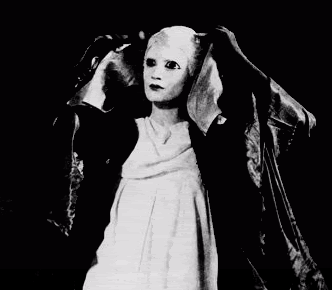
or Orpheus
The second film in Cocteau's Orphic Trilogy (in chronological and thematic order: The Blood of a Poet, Orpheus, The Testament of Orpheus). If you're not familiar with the myth, I included a wikipedia article on it under the links at the bottom of the post. Not to suggest that the film really adheres to the actual myth, but knowing the story certainly facilitates one's understanding of the film.
That said, I recommend you watch Orpheus before reading any further.
Of the three films in the trilogy, Orpheus is the most accessible, being the only one with anything like a story. But it is like Beauty and the Beast in the sense that much of the story seems arbitrary; we receive no explanations or reasoning, we must merely accept these things that happen and the decisions that the characters make.
Those characters, of course, are those plotted out in myth: Orpheus and Eurydice. The story in the film is placed in then-contemporary France, and the myth is altered significantly, leaving only some basic similarities. We have Orpheus and Eurydice (keeping the original names, despite the setting), we have the death of Eurydice, Orpheus crossing into Hades, the return, and the subsequent loss of Eurydice. Even the Maenads (the Bacchae) are represented by a bunch of feisty youngsters that kill Orpheus. Yet Cocteau's adherence to the myth seems based largely on convenience, because most of the story works within its own framework and merely borrows from the myth (more conceptually, with Cocteau's obsession about the nature of a poet, than literally).
The use of the myth isn't what interests me here. It's used well enough, and with originality, but it's something else that makes this film work.
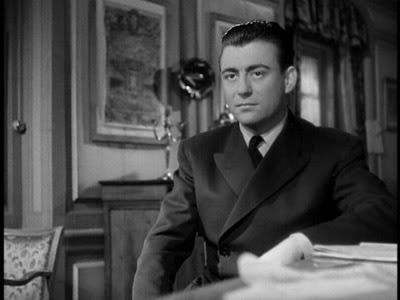 Heurtebise.
I know Cocteau only in the context of his films. I've seen snippets of his art, I've read a poem or two, but I've only heard of his novels and plays. But from what I've read, Heurtebise was a sort of muse, an angel/demon, an entity that permeated Cocteau's work. I've linked two articles at the bottom of the post that give some brief background (the topic is elusive, so it's hard to find anything concrete). It happened after the death of a friend and (presumed) lover:
"As legend has it, Cocteau was standing in an elevator when the angel spoke to him and divulged his name: it was the same as that of elevator manufacturer Heurtebise."
Afterward, he wrote the poem "L'Ange Heurtebise". The character found its way into the play Orpheus, and then made his way into the film. And it's this character that seems to make the film work.
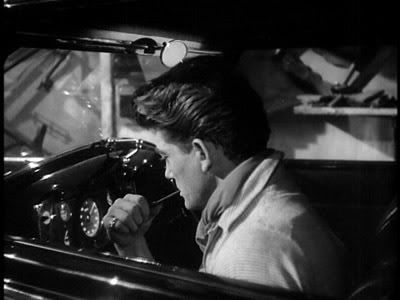
It's filled with plenty of other fascinating things, of course. I love the everyday quality of the supernatural, a sort of magical realism: motorcyclists as harbringers of death, a car radio that receives transmissions from a dead poet, the bureaucracy of limbo.
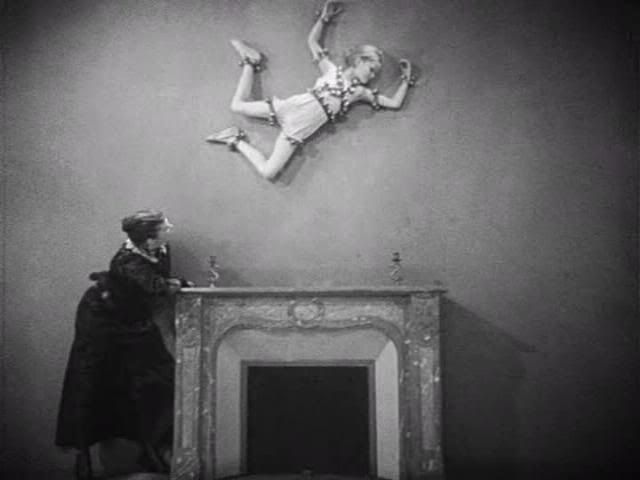
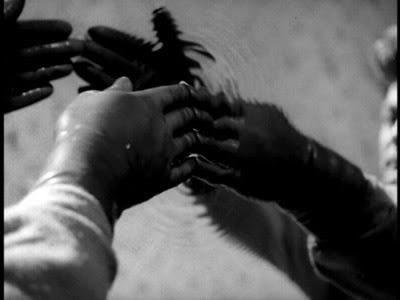
We have Cocteau's trick photography, often tricks from his previous films, but they still manage to work, to capture one's attention in unexpected ways. My favorites are the altered perspective set in the underworld, where Heurtebise and Orpheus fall sideways, and Orpheus putting the rubber gloves on in reverse.
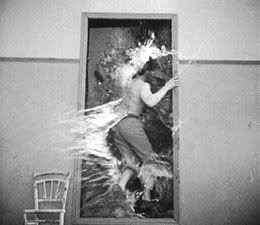
A return of Cocteau's obsession with mirrors; his use of a vat of mercury to make the liquid-mirror effect is brilliant. Again, Cocteau manages a kind of casual poetry in the dialogue; for instance, when Heurtebise speaks of mirrors:
"Mirrors are the doors through which death comes and goes. Look at yourself in a mirror all your life, and you'll see death at work, like bees in a hive of glass."
It's beautiful, yeah, but this line also defines the essence of the film: the inconstant borders between life, identity, love, death, poetry, immortality. Heurtebise is at the center of all of this.
There's still plenty to do with Orpheus and the others. Orpheus is troubled with his identity as a poet, and Eurydice is concerned for him. Love and death are inextricably bound together, as they are in the original myth, and the love network is complex and clearly meaningful (Orpheus and his death loving one another, especially).
But Orpheus is too capricious to keep track of. He may have some feelings for Eurydice, but they are overshadowed by his obsession with the car radio poetry and his love of the princess. Yet at the end, they seem happily reunited in life. I don't presume to know what everything means, things change too often to settle on a satisfying answer, but it seems that the only reliable vein of interpretation lies in Heurtebise. He is the only character who seems wholly certain about who he is, where he is, what's happening.
He and Eurydice are the innocents of the film, the honest characters. Orpheus and the princess are manipulative and obsessed, egotistic and easily distracted. Their love feels false, although whether that's Cocteau's intent or my own reaction it's hard to say; I suspect it's just the latter. And while Orpheus is yearning for his death, Eurydice patiently yearns for him to return to her. Yet even when she dies, Orpheus ventures into the underworld not for her, but to seek out his own mortality.
Heurtebise, of course, has fallen in love with Eurydice. You saw what happened. Heurtebise is quiet about it, restrained, full of the self-sacrificial virtue. Eurydice is too worried about Orpheus to notice, at least not until Heurtebise must declare it outright at the trial, and by then it's too late. I like that they have trials in a place where people can't lie. Something about it seems very intimate, to be forced to admit something in those circumstances.
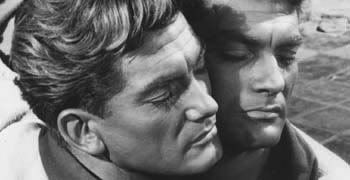
Anyway, I leave the film wondering whether Orpheus is supposed to be arrogant, self-absorbed, uninspired, the image of the poet without the substance, without the essence. Heurtebise and even the princess commit an act of self-sacrifice to restore Orpheus and Eurydice to supposed happiness. That pleases Eurydice well enough, I'm sure, but she's oblivious to any real suffering. Heurtebise, who is dead because he committed suicide, who is a servant in the afterlife, who falls into unrequited love, who sacrifices himself, who is not a poet but who has all the admirable traits a poet should have. He does not waver. He takes pain and frustration with the impassive professionalism one would expect of a chauffeur.
It's hard to define what exactly it is about Heurtebise that affects the film so profoundly; even as the most consistent character, he is perhaps the most difficult to understand. Surely a significant part of it is his tolerance, his role as the angel, patient and guiding even when we feel he should have left Orpheus long ago. In fact, we're never quite sure why Heurtebise dedicates himself so fully to Orpheus. He guides without any clear motivation, sacrifices without any benefit, but still he travels alongside the poet.
Perhaps Heurtebise is the spirit who guides a man through his mortality, who opens up the mirror into the self, who makes the man a poet.
We will discuss Heurtebise again, when I write about The Testament of Orpheus. I'd also like to mention one more thing, though:
Orpheus was made in post-war France, and the atmosphere is prevalent in the film. The ruins Orpheus wanders through in the static limbo are buildings that were actually bombed out during the war. The committee that the princess, Orpheus, and Heurtebise must stand before is based on such trials held in occupied France. Interesting, that Cocteau should impliment these features in his underworld.
Below are links with extra information on them (I recommend, once again, reading Cocteau's essay on the Criterion site), the Orpheus myth, and the background on Heurtebise as he exists throughout Cocteau's work.
Links:
Film Reference
Criterion Collection
Criterion Contraption
Orpheus myth:
Wikipedia
Heurtebise links:
Background 1
Background 2